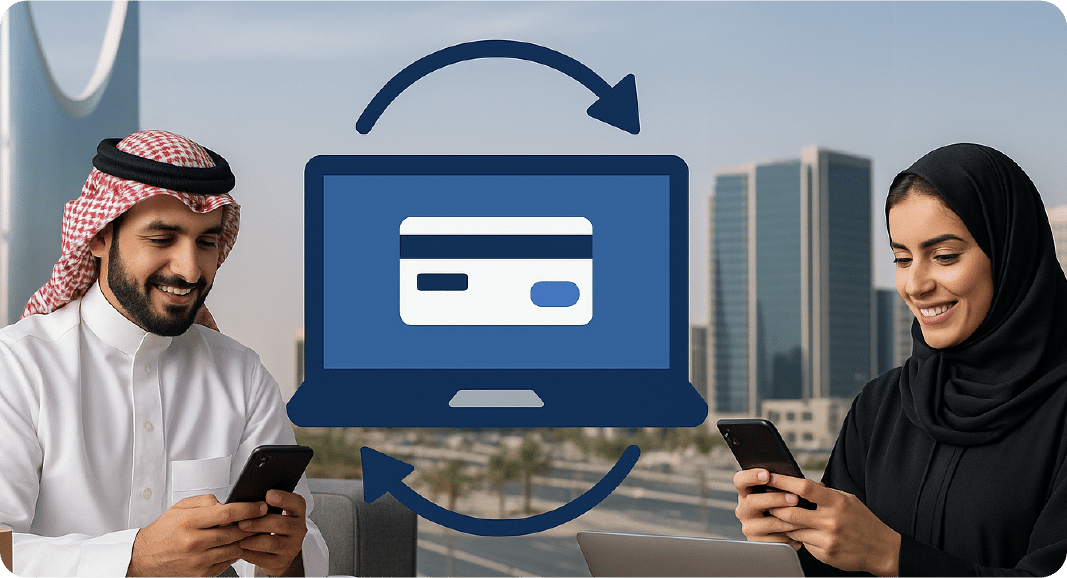
When completing an online purchase, it may seem to the customer that the process is simple: just enter the card details, click the “Pay” button, and wait for a success message.
However, behind this seemingly straightforward action lies a sophisticated system of interconnected processes that occur within milliseconds to ensure transaction security, data validation, and proper fund transfer.
At MyFatoorah, we believe transparency and awareness are essential parts of the merchant experience.
That’s why, in this article, we’ll walk you through a real-life, educational journey to explain what happens from the moment the customer enters their card details to the moment funds reach your business account.
Who Are the Key Players in a Payment Transaction?
In any electronic payment system, several key parties work together in harmony to ensure a smooth, secure, and successful transaction.
In many cases, the merchant does not directly integrate with the payment gateway or banking networks. Instead, they work with a specialized platform like MyFatoorah, which provides all necessary tools for seamless technical and commercial integration with both local and international payment systems.
What does the integration provider offer?
- A user-friendly, embedded payment interface, easily linked to your website or app within minutes.
- Advanced and flexible APIs for integration with stores, invoicing systems, subscriptions, and more.
- Top-tier encryption and fraud protection systems to secure card data.
- Real-time tracking tools via a comprehensive dashboard showing all payment statuses and transaction reports.
This role goes beyond simple facilitation — it enhances the end-user experience and simplifies operations for both merchants and customers.
The payment gateway is the actual starting point of transaction processing.
When the customer enters their card details (card number, expiration date, CVV), MyFatoorah’s gateway begins analyzing the data according to precise rules:
- Is the card still valid?
- Is the card number properly structured? (Including checks like the Luhn algorithm)
- Are the details immediately encrypted using secure protocols like TLS to prevent interception?
The data is then passed to what’s known as the payment processor, which is responsible for executing the transaction and communicating with the banks and card networks.
Note: In some cases, the gateway and processor are the same entity, and in others, they are separate companies working in sync.
At MyFatoorah, we partner with global leaders in processing to ensure maximum reliability and efficiency at this stage.
This is the commercial bank that holds the merchant’s business account.
When the processor receives transaction details, it forwards them to the acquiring bank, which performs the following:
- Identifies the card type: Is it Visa? Mastercard? mada? Amex?
- Selects the appropriate card network based on the card type and issuing bank.
- Submits an authorization request to the selected card network.
The acquiring bank acts as the financial bridge between the merchant and the broader payment ecosystem and is ultimately responsible for transferring the funds to the merchant.
Well-known card networks include:
Visa, Mastercard, mada, American Express, Discover, and others.
Their role includes much more than routing requests. They also:
- Verify card information for accuracy.
- Enforce global security standards like 3D Secure.
- Analyze transaction behavior to detect potential fraud.
- Forward the request to the issuing bank, which makes the final approval or rejection decision.
Card networks are the backbone of global electronic payments, ensuring that every transaction meets strict safety and performance criteria.
At this stage, the request reaches the final decision-maker — the bank that issued the customer’s card.
The issuing bank checks several factors:
- Is the card valid and active?
- Is there enough available balance or credit limit?
- Are there any restrictions or holds on the account?
- Is the transaction consistent with the customer’s typical behavior?
If approved, the issuing bank generates an Authorization Code, which travels back through the same chain in reverse:
From the issuing bank → to the card network → to the acquiring bank → to the processor → to the gateway → to the merchant → and finally, the customer sees:
“Payment Successful”
What Happens After a Successful Payment?
The Settlement Stage
Just because a transaction was successful doesn’t mean the funds instantly appear in the merchant’s account.
There’s a second critical step called Settlement, where the actual fund transfer occurs.
How Settlement Works with MyFatoorah:
- Daily Transaction Compilation: At the end of each business day, our system compiles all the completed transactions on your account.
- Submitting Settlement Requests: Requests are submitted to the relevant issuing banks to collect the owed amounts.
- Transfer of Funds (minus fees):
- Card network fees (Visa / Mastercard / mada)
- Processor fees
- Payment gateway fees (depending on your plan)
- Deposit to Merchant Account:
- According to your preferred payout schedule:
- Daily (Sun – Tue – Thu)
- Weekly
- Monthly
- With full flexibility to pause and resume payouts anytime.
Why Choose MyFatoorah for This Journey?
✔ Officially licensed and regulated by the Saudi Central Bank
✔ Bank-grade encryption and security standards for customer data
✔ Direct support from technical engineers to resolve API or integration issues
✔ Real-time transaction reports and dashboards
✔ Full invoice and message branding customization for your store
✔ Transparent, flexible settlement options tailored to your business
Conclusion:
Every successful online payment goes through a sophisticated and secure network of systems and checks.
From the integration provider (like MyFatoorah) to the issuing bank, each party plays a vital role in ensuring the transaction is legitimate, secure, and completed successfully.
Understanding this journey helps merchants appreciate the robust infrastructure powering each sale.
With MyFatoorah, all this complexity is handled behind the scenes, leaving you with a simple, seamless, and secure experience — for you and your customers alike.